

Advertisement

Advertisement
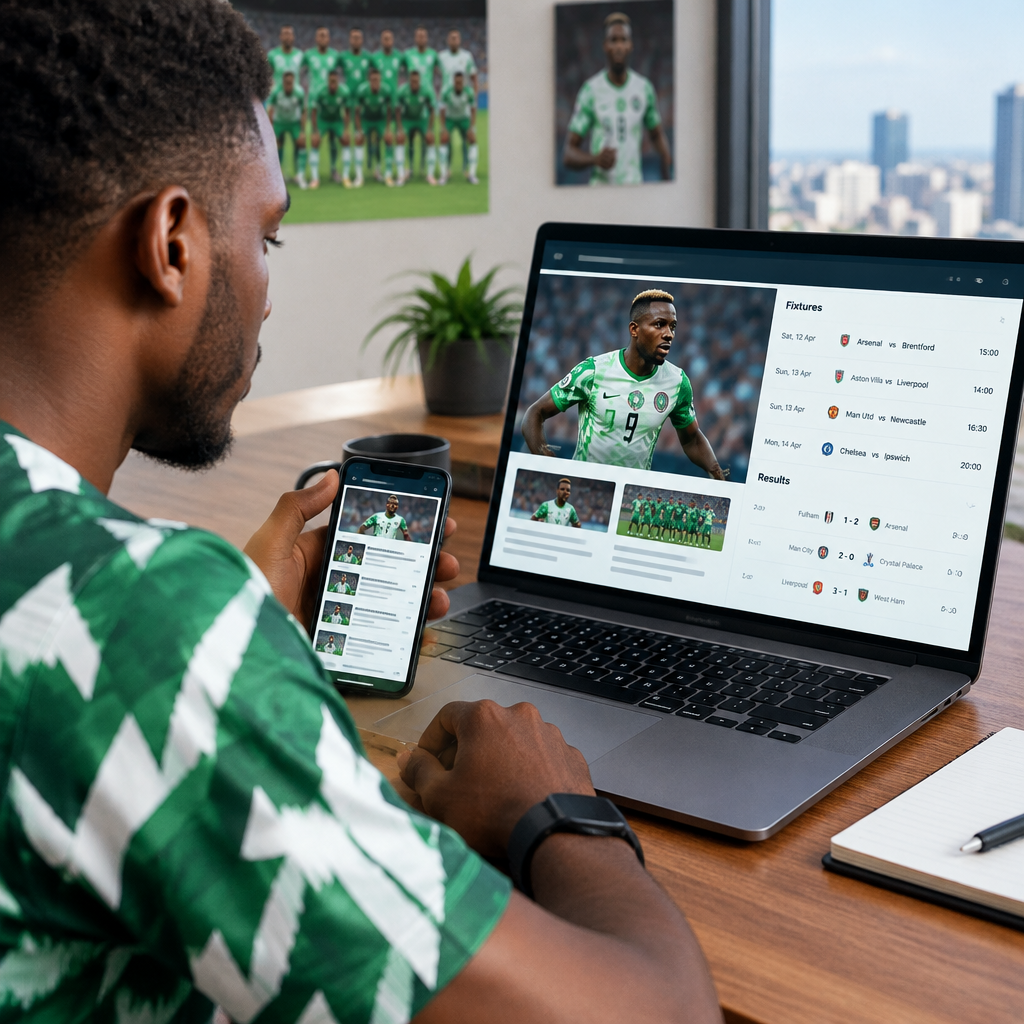
Following Nigerian footballers in Europe, Asia, North America or other parts of the world can be difficult when each player represents a different club, competition and time zone. Match schedules may appear on separate websites, some games may not be broadcast in Nigeria, and social media can mix confirmed news with rumours.
The good news is that you do not need to search for every player from scratch. With a simple system using fixture pages, livescores, official club channels and trusted football reporting, you can keep track of appearances, goals, assists and important team news more reliably.
Advertisement
Table of Contents
Start with a personal list of players
First, create a list of the Nigerian players you want to follow. Include their full name, current club, position and competition if you know it. This helps you avoid confusing players with similar names and makes it easier to find the correct fixture.
Your list can include:
- Players in major European leagues and competitions
- Nigerians playing in Africa, Asia, North America or the Middle East
- Players in lower divisions who receive less international coverage
- Nigerian-born players who represent another national team, if they interest you
- Players involved with Nigeria’s senior or age-grade national teams
Do not assume that a player is still at the same club because an old article, video or social media post says so. Clubs, loan arrangements and competition roles can change. Confirm the player’s club through the club’s official website, a reputable football database or recent reporting from a reliable sports outlet.
Use fixture and livescore services for the basic schedule
Livescore services are useful for checking which Nigerian players may be playing on a particular day. Search for the club rather than only the player’s name, then open the club’s upcoming fixtures and recent results.
When checking a fixture, pay attention to:
- The competition and round
- The scheduled date and kick-off time
- The venue and whether the club is playing at home or away
- Whether the time is displayed in Nigerian time or your device’s local time
- Any postponement, cancellation or schedule change
Some services allow you to follow a club or receive notifications. These alerts can be helpful, but they are not always enough to prove that a player actually took part. A fixture tells you that the club played; it does not confirm that the Nigerian player was selected, entered the match or completed the game.
Check the line-up before deciding whether a player is involved
The most useful moment to check a match is shortly before kick-off, when the starting line-up and substitutes are normally announced by the club, competition organiser or another reliable match service.
A player may be:
- In the starting eleven
- Named among the substitutes
- Unavailable because of injury, suspension or illness
- Left out for a tactical or selection reason
- Absent because the club is managing the player’s workload
Being named on the bench is not the same as making an appearance. During the match, check substitutions and the final match report to see whether the player entered the game.
This distinction matters when reading headlines such as “Nigerian star features for club”. The phrase may refer to a starting appearance, a late substitute appearance or simply a place on the matchday squad. Read the details before sharing the claim.
Follow official club and competition channels
Official club channels are usually the best place to find confirmed line-ups, substitutions, goals, disciplinary incidents and post-match reports. Look for the club’s verified website, application or social media account. Competition organisers may also publish official fixtures, results and statistics.
For each player, consider following:
- The player’s current club website and official social accounts
- The league or competition’s official match centre
- The club’s verified matchday account
- The player’s verified social media account
- The relevant national team’s official channels
Official sources can still use short matchday language, so readers should distinguish between a club announcement and a supporter’s interpretation. A club confirming that a player is injured is different from a fan account guessing when the player will return.
Use broadcasters and legal streaming options
If you want to watch a match rather than only follow the score, check the rights holder for the competition in your location. Broadcast arrangements differ by country and may change between competitions or seasons.
Look at the official website or app of the league, competition, broadcaster or authorised streaming service. Before paying for access, confirm that:
- The service is available in Nigeria or your current country
- The specific competition is included
- The match is scheduled for live coverage rather than only highlights
- The advertised price and renewal terms are clear
- The website or application is genuine
Avoid websites promising every football match for free when they ask you to install unknown applications, provide card details on suspicious pages or disable your device’s security settings. Unofficial streams can expose users to malware, aggressive advertising and phishing attempts.
Build a simple weekly tracking routine
You can follow several players without spending the whole day searching. A practical routine is to check information at four stages.
- Before the weekend or match period: Review upcoming fixtures and note the clubs involving Nigerian players.
- Before kick-off: Check the confirmed line-up and whether the player is a substitute or unavailable.
- During the match: Use a reliable live match centre for goals, substitutions, cards and other key events.
- After the match: Read the final result and official report, then confirm the player’s minutes, goal, assist or other contribution before sharing it.
A notes app, calendar or spreadsheet can help. Record the player, club, competition, fixture, result and appearance status. This is especially useful for readers who follow many footballers or prepare football updates for a website and social media page.
Understand the difference between common match terms
Football reports often use terms that are easy to misunderstand:
| Term | Meaning |
|---|---|
| Started | The player was in the starting line-up. |
| Appeared | The player took part in the match, either from the start or as a substitute. |
| Unused substitute | The player was named on the bench but did not enter the game. |
| Matchday squad | The player was selected for the match group, but this does not always mean an appearance. |
| Available | The player could be selected, but the term does not confirm selection or participation. |
| On target | A shot was directed towards the goal in a way that could result in a goal; it is not a goal or assist. |
Check injury and transfer news carefully
Injury updates, transfer reports and selection news attract attention, but they are also areas where rumours spread quickly. Treat an unnamed source, edited video or unsourced social media post as unconfirmed.
For an injury, look for a statement from the club, manager, player or a clearly identified journalist quoting a source. For a transfer, confirmation normally comes from the club, player or an established football news organisation. A player being photographed at an airport or removed from a squad does not by itself prove that a transfer has been completed.
Remember that a loan move, contract agreement and completed registration are not always the same thing. Until the relevant club or competition confirms the move, describe the report as a rumour or developing story rather than a fact.
Use social media without letting it replace verification
Social media is valuable for quick updates, player reactions and behind-the-scenes content. It is less reliable when an account has no clear identity, copies another page’s branding or posts dramatic claims without evidence.
Before reposting an update, ask:
- Who first published the information?
- Is the account official or clearly identifiable?
- Does the club, competition or player confirm it?
- Could the post be old content being presented as new?
- Does the wording distinguish fact from opinion?
For news readers in Nigeria and Nigerians abroad, this short verification step can prevent false claims about goals, injuries, transfers and national-team invitations from spreading.
Make time zones work for you
International fixtures may begin very early in the morning or late at night in Nigeria. Check the time displayed by the match service and compare it with your phone’s time-zone settings. Do not rely on a graphic shared several days earlier, because kick-off times can change.
If you set reminders, create them from a trusted fixture page and leave room for schedule changes. This is more dependable than memorising a time from a social media post.
What to do when information is missing
Sometimes a player’s statistics will not appear immediately, especially in smaller competitions. Do not fill the gap with an assumption. Check the final score, official team report and a second reputable match source. If the information still cannot be confirmed, say that the player’s involvement has not yet been verified.
The most reliable approach is to combine a livescore service for speed, official club and competition channels for confirmation, and reputable football reporting for context. That system helps you follow Nigerian players accurately without confusing a rumour, a squad selection and an actual appearance.
Useful takeaway: track the club first, verify the line-up, confirm the final appearance and only then share the player’s result. This simple order keeps football updates clear, fast and trustworthy.
Advertisement
