

Advertisement

Advertisement
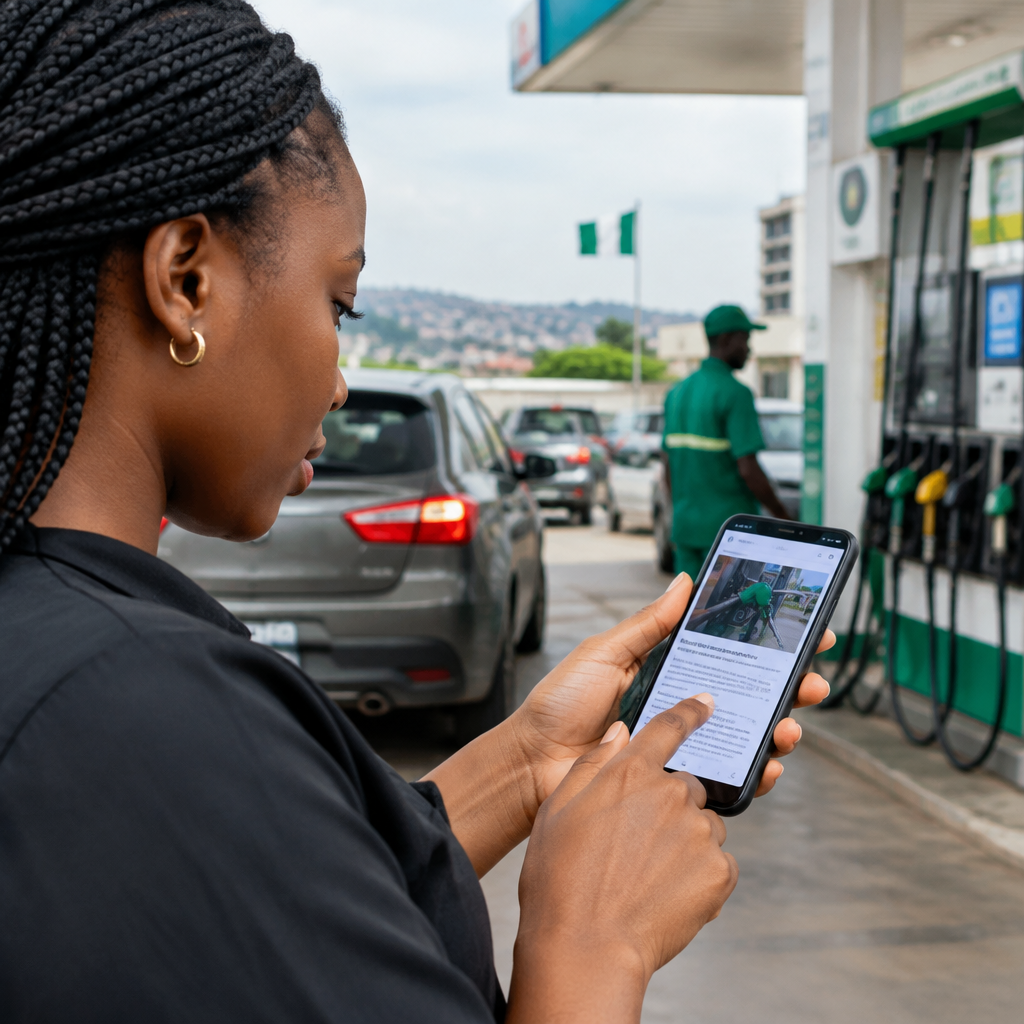
A message saying that petrol prices have increased or reduced can spread across WhatsApp, Facebook and other platforms within minutes. For drivers, transport workers, businesses and households, the information may affect travel plans, delivery costs and daily budgets.
But not every fuel price report describes a confirmed nationwide change. Some reports refer to one filling station, one city, a private negotiation, an expected adjustment or an old price being presented as new. Before forwarding the information, check what exactly has changed, where it applies and who has confirmed it.
Advertisement
Table of Contents
Start with the most important question: what price is being reported?
“Fuel price” can mean different things. A report may refer to:
- Retail pump price: the amount customers pay at a filling station.
- Depot or wholesale price: the amount charged before the product reaches many retail outlets.
- Official or recommended price: a figure announced or referenced by a government body, supplier or industry organisation.
- Local selling price: the amount charged by a particular station in a particular area.
- Expected price: an estimate based on market conditions, not a confirmed amount.
A change in a depot price does not automatically mean every filling station has changed its pump price. Transport costs, supply availability, station operating expenses and local competition can also produce differences between locations.
Check the date, location and product
A credible report should make clear when the information was observed or announced. Fuel prices can change, and an old screenshot may continue circulating long after the situation has changed.
Also check whether the report applies to Nigeria generally or only to a state, city, local government area or named station. A price observed in Lagos, Kano, Port Harcourt or Abuja should not automatically be presented as the price across the country.
Confirm the product as well. Petrol, diesel and kerosene are different products with different supply chains and pricing conditions. A report about diesel should not be rewritten as a petrol report simply because both are commonly discussed as fuel.
Look for an identifiable source
Before sharing, identify who made the claim. Stronger sources usually include:
- An official statement or public notice from a relevant government regulator or agency.
- A named petroleum marketer, supplier, depot operator or industry association.
- A report from a reputable news organisation that identifies its source and publication date.
- A clearly dated observation from a named filling station, provided it is not falsely presented as a national announcement.
Be more cautious when the message says only “breaking news,” “according to a reliable source” or “prices will change tonight” without naming the source. A logo, official-looking design or widely shared screenshot does not prove that the information is genuine.
When reading an official statement, check that it comes from the organisation’s verified website or recognised social-media account. Do not rely only on a copied image or a forwarded message. Impersonators can reproduce agency logos and use them to make false claims appear authoritative.
Separate confirmed changes from forecasts and rumours
Fuel-market reporting often includes several kinds of claims. They should not be treated as equal:
| Type of claim | What it means | How to describe it |
|---|---|---|
| Confirmed announcement | An identifiable authority or company has issued a clear statement. | “The organisation announced…” |
| Observed local price | A price was seen at a particular station or location. | “The station was selling at…” |
| Industry expectation | People in the sector anticipate a possible change. | “Industry sources expect…” |
| Unverified report | The claim is circulating but its source cannot be confirmed. | “An unverified message claims…” |
Using the wrong wording can mislead readers. “Petrol prices have increased nationwide” is much stronger than “some stations are reportedly selling at a higher price.” Only use the stronger statement when the evidence supports it.
Check whether the number is complete
A price figure without context may be difficult to interpret. Before sharing it, ask:
- Is the amount per litre?
- Is it a pump price, depot price or estimate?
- Does it include any stated charges or transport-related differences?
- Is it the old price, new price or proposed price?
- Where was it recorded?
- When did the reported price take effect or when was it observed?
Also watch for missing decimal points, cropped screenshots and captions that do not match the original report. If the number appears unusually low or high, do not repeat it until the original source and context have been checked.
A simple verification workflow for readers
Use this short process before forwarding a fuel-price message:
- Open the original post or article. Do not rely only on the text copied into a chat.
- Find the publication date. Treat undated content as unconfirmed until its timing is established.
- Identify the source. Look for a named agency, company, station, spokesperson or publication.
- Read beyond the headline. The article may say that a change is expected rather than completed.
- Check the location and product. Confirm whether it is petrol, diesel or another product and whether the claim is local or national.
- Compare with another credible source. Independent confirmation is especially important for claims about a nationwide change.
- Use careful wording if uncertainty remains. Explain what is confirmed and what is still developing.
Common signs that a report needs caution
- It uses urgent language but provides no source.
- It contains an old date or no date at all.
- It claims a nationwide change based on one filling station.
- It mixes petrol prices with diesel or another product.
- It says “from midnight” or gives a future effective date without an official notice.
- It asks readers to forward the message immediately.
- It uses a familiar organisation’s logo but links to an unrelated page.
- Several pages repeat the same wording but all appear to have copied one unverified post.
How publishers and community administrators should write the update
A useful report should state the confirmed information first, then explain its limits. For example, if a named station has been observed selling petrol at a particular amount, report the station and location rather than presenting the figure as Nigeria’s universal pump price.
If an official announcement exists but implementation details are unclear, say so. Readers need to know whether the announcement applies immediately, to certain suppliers, to a particular product or only to a specific area.
For developing stories, include a clear update time and revise the article when better information becomes available. Do not quietly leave an outdated headline online after the underlying position has changed.
Why careful sharing matters
False fuel-price reports can cause unnecessary panic buying, long queues and confusion for commuters. They can also lead people to accept inflated prices without asking questions or to make business decisions using an outdated figure.
For households and small businesses, the safest approach is to use verified information for planning while recognising that prices may differ by station and location. A report can be useful without pretending to provide one fixed price for everyone.
The practical takeaway
Before sharing a Nigerian fuel-price report, confirm five basics: the source, date, location, product and type of price. Then check whether the claim is an official announcement, a local observation, an expectation or an unverified rumour. If any of those details are missing, share the uncertainty instead of presenting the message as established fact.
Advertisement
