

Advertisement

Advertisement
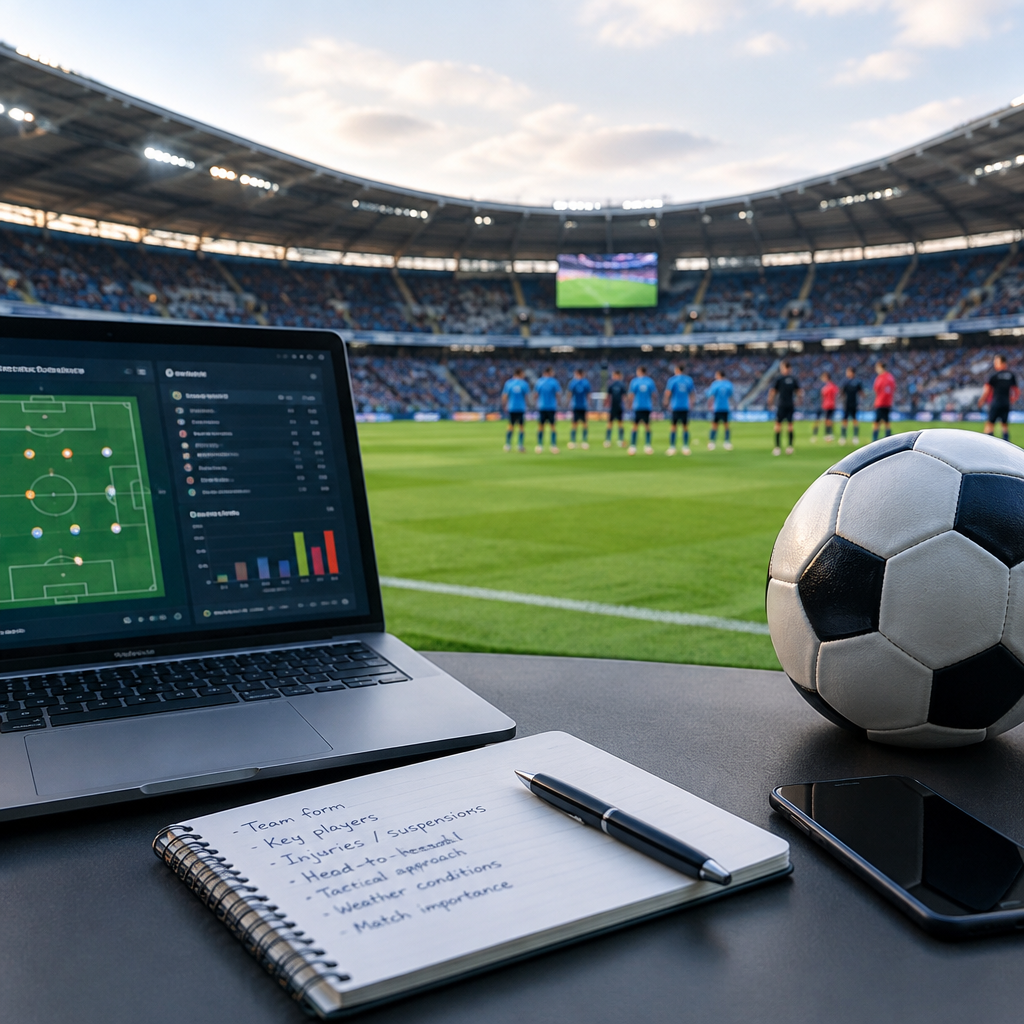
A football match preview should help you answer a simple question: what is likely to shape this game before the players step onto the pitch?
Many previews only repeat the fixture, competition and kickoff time. Those details are useful, but they do not explain whether a match could be open, defensive, closely contested or decided by one important absence. A stronger preview brings together team form, tactics, player availability, motivation and reliable match information.
Advertisement
This guide is useful for fans following local leagues, European competitions and Nigerian players abroad. It also helps readers who use football news and livescore platforms but want more context than a scoreline alone can provide.
Table of Contents
Start with the basic match information
Before analysing the teams, confirm the foundation of the preview:
- The competition and stage of the tournament
- The home and away teams
- The venue
- The scheduled kickoff time and time zone
- Whether the match is a league game, cup tie, playoff or two-leg fixture
These details affect the meaning of the result. A league match may reward consistency over a long season, while a cup game can be shaped by the need to protect a first-leg advantage or chase a required number of goals.
Kickoff times should be checked from a reliable fixture source, especially when readers are following matches from Nigeria or abroad. Schedules can change because of television arrangements, stadium issues, weather or competition decisions.
Compare recent form without treating it as a guarantee
Recent form is one of the most visible parts of a preview, but it needs careful interpretation. Look beyond a simple sequence of wins and losses.
Ask questions such as:
- Who did each team face?
- Were the matches at home or away?
- Did the team create chances but fail to score, or was it outplayed?
- Did the side rotate its squad because of another competition?
- Did the results come against opponents with similar quality?
A team that has won three matches against weaker opposition may face a more difficult test than a side with fewer wins earned against strong opponents. Likewise, a defeat does not always mean poor performance. A team can lose narrowly after controlling much of a match.
Recent form is best used as evidence of current confidence, rhythm and defensive or attacking habits, not as proof of what must happen next.
Study the tactical matchup
The most useful part of a match preview often explains how the teams may try to play.
One team may prefer to keep possession and build attacks patiently. The other may sit deeper, defend compactly and attack quickly after winning the ball. A high-pressing side may cause problems for a team that struggles to play out from defence. However, pressing aggressively can also leave space behind the defensive line.
Consider these tactical questions:
- Which team is likely to control possession?
- Can the defending team handle crosses, set pieces or quick switches of play?
- Does either side depend heavily on counterattacks?
- Are the full-backs likely to push forward and leave space behind them?
- Which midfield controls the tempo?
A preview does not need complicated tactical language. It can simply explain the likely battle: for example, whether one side must break down a low defensive block or whether both teams may leave space during transitions.
Check confirmed team news and player availability
Injuries, suspensions and rotation can change a match significantly. A missing goalkeeper, central defender or holding midfielder may affect a team differently from the absence of a wide attacker.
Before kickoff, separate confirmed information from uncertainty. A player can be described as unavailable when the club or competition authority has confirmed an injury or suspension. A player described as doubtful may still feature. Social media speculation should not be presented as fact.
Important availability questions include:
- Who is suspended?
- Which injuries have been officially reported?
- Are returning players match-fit or likely to start on the bench?
- Has the team recently played several matches in a short period?
- Could rotation affect the starting eleven?
Starting line-ups are normally confirmed close to kickoff. Until then, a responsible preview should use phrases such as “could start”, “may be rested” or “is expected to be assessed”, depending on the quality of the information available.
Look at home advantage and match conditions
Home advantage is more than playing in familiar surroundings. It can involve travel demands, crowd support, pitch familiarity and the home team’s willingness to attack early.
For away sides, travel and a hostile atmosphere may create additional pressure, especially in important knockout matches. But home advantage is not an automatic prediction of victory. Some teams perform better away because they can defend and counterattack without carrying the expectation to dominate possession.
The venue and pitch can also matter. A narrow or poor playing surface may reduce the effectiveness of a possession-based approach. Weather may affect the speed and physical demands of the game, but such claims should be based on reliable information rather than guesswork.
Understand motivation and the competition situation
Two teams may enter the same match with different priorities. A club fighting for a title, continental place or survival may approach the game with greater urgency. Another may be protecting players for a more important fixture a few days later.
In a knockout tie, the score from the previous leg can completely change the tactical plan. A team leading the tie may accept a slower game, while the trailing side may need to take more risks. In a league match, a draw may be valuable for one team but disappointing for another.
Good previews explain what each side needs from the result. They do not assume that every team will play at maximum attacking intensity from the first minute.
Use head-to-head records carefully
Previous meetings can provide context, particularly when the same managers, tactical systems or key players remain involved. However, old results should not dominate a preview.
Teams change. Managers leave, players transfer, and a match played several seasons ago may have little connection to the current contest. Head-to-head records are most useful when they reveal a recent and relevant pattern, such as one side consistently struggling against the other’s pressing style or set-piece delivery.
A long list of historic results can create false confidence. Current team news and tactical conditions usually deserve more attention.
What a balanced prediction should look like
A prediction should reflect evidence and uncertainty. It should explain the possible match script rather than present an outcome as guaranteed.
For example, a balanced preview might say that the home team has the stronger recent performances and should see more of the ball, while the visitors could threaten on counterattacks. That gives the reader a reasoned view without claiming certainty.
Be especially careful with betting-related language. Football is unpredictable, and a preview is not a guarantee of profit. Readers should never treat an opinion, score prediction or injury rumour as a certain outcome. Avoid presenting gambling as an income strategy.
A practical pre-kickoff reading workflow
Before making up your mind about a match, use this short process:
- Verify the fixture: Confirm the competition, venue and kickoff time.
- Review meaningful form: Compare recent opponents, home and away results and performance trends.
- Check official team news: Separate confirmed absences from rumours.
- Identify the tactical battle: Consider how each team attacks, defends and responds under pressure.
- Assess motivation: Look at the league table, knockout score and upcoming schedule.
- Read the uncertainty: Note factors that could change after line-ups are announced.
Once the starting line-ups are confirmed, revisit the preview. A tactical expectation may change if a key midfielder is missing, a striker is unexpectedly rested or a team uses a different formation.
The main takeaway before kickoff
The best football match preview does not pretend to know the final score. It helps you understand the conditions that could influence it.
Start with verified fixture details, then examine form, tactics, availability, motivation and venue. Treat historical records as supporting context, not decisive evidence. Finally, distinguish confirmed information from predictions and rumours.
That approach makes football coverage more useful, whether you are following a Nigerian club, tracking a favourite player abroad or checking a livescore before watching the match. The goal is not to remove uncertainty. It is to understand it clearly before kickoff.
Advertisement
