

Advertisement

Advertisement
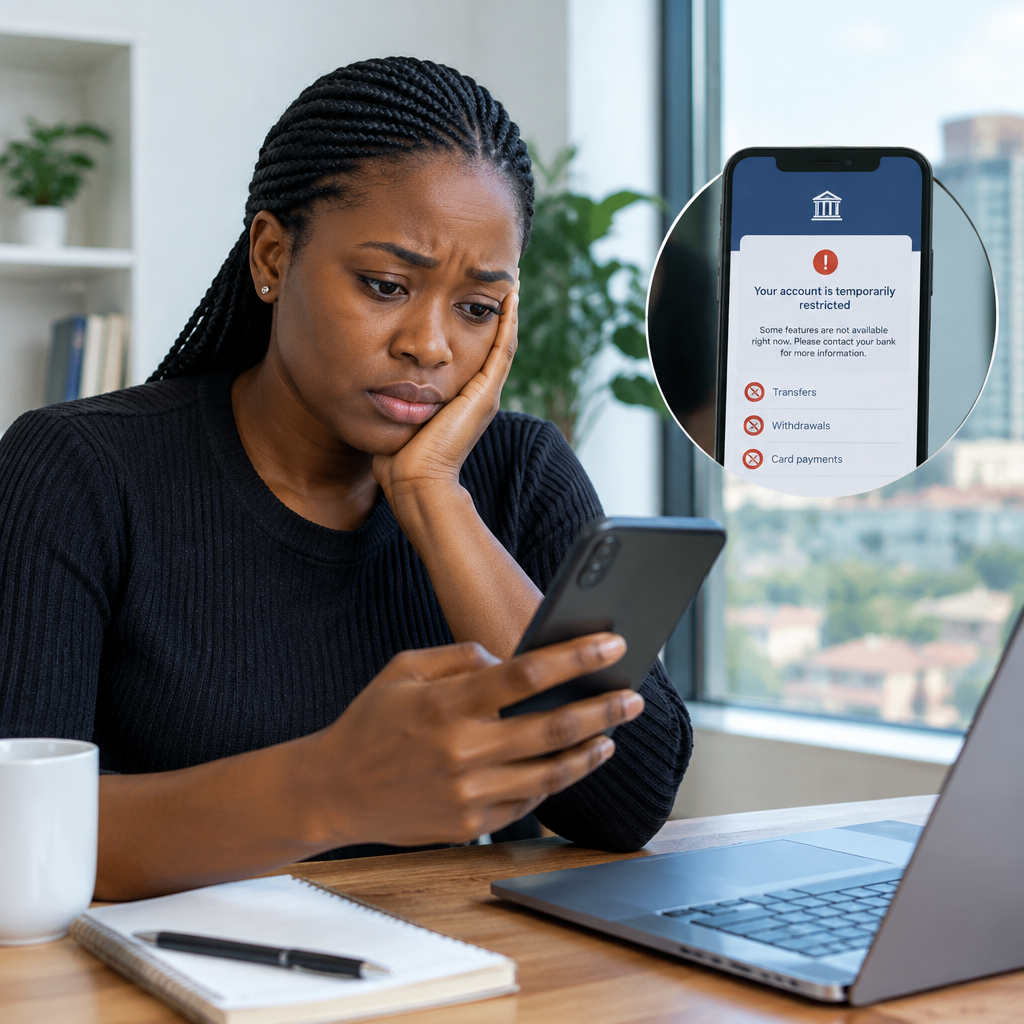
When a bank account is temporarily restricted, you may be unable to withdraw cash, transfer money, use your debit card or access some online-banking features. The restriction can be worrying, especially when you need money for transport, bills, school fees, business or an urgent payment.
A restriction does not always mean that your money is gone or that you have committed a crime. Banks may limit an account because of unusual activity, incomplete customer information, a security concern, a legal instruction or a technical problem. The safest response is to contact the bank through an official channel, understand what is being requested and provide only the information that is genuinely required.
Advertisement
Table of Contents
What does a temporary account restriction mean?
A restricted account is an account with one or more banking services limited for a period of time. The restriction may affect:
- ATM withdrawals;
- transfers to other bank accounts;
- debit-card payments;
- mobile or internet banking;
- cash deposits or withdrawals; or
- the entire account.
Some restrictions are narrow. For example, your card may be blocked while transfers still work. In other cases, the bank may place a wider hold while it reviews the account.
The wording used by banks can differ. A failed transaction, card block, account freeze, debit restriction, compliance review and a temporary service outage are not necessarily the same thing. Ask the bank exactly which service is restricted and whether the issue affects your balance or only your access to it.
Common reasons a bank may restrict an account
Unusual or suspicious activity
A sudden large transfer, several transactions from unfamiliar locations or activity that does not match your normal pattern may trigger a security review. This can happen after a phone, password or SIM-related incident, or when a device is used in an unusual way.
Incomplete or outdated customer information
Banks may ask customers to update identification or other account information. In Nigeria, account onboarding and verification can involve details such as Bank Verification Number (BVN) or National Identification Number (NIN), depending on the bank, account and applicable requirements. Do not assume that a message requesting an update is genuine. Confirm the request directly with your bank.
Possible fraud or an unauthorised transaction
If the bank detects suspected fraud, or if you report a transaction that you did not authorise, it may limit certain services while checking what happened. A restriction may also protect the remaining balance from further unauthorised activity.
Legal, regulatory or third-party instructions
An account can be affected by a formal legal or regulatory process. In that situation, the bank may not be able to remove the restriction immediately or disclose every detail. Ask what general explanation the bank is permitted to provide and what review or response process applies.
Technical or account-access problems
Sometimes the problem is not a full account restriction. A banking app may be unavailable, a transaction may fail because of a network issue, or a card may have been disabled after several incorrect PIN attempts. Checking another official access channel can help identify the difference.
What to do first
1. Stay calm and record the exact problem
Write down what happened, including the date, time, transaction type and error message. Note whether the issue affects your card, ATM access, mobile app, transfers or the complete account. If a transaction is pending, failed or reversed, record that separately.
Do not repeatedly retry a transaction that has already failed. Multiple attempts can create confusion, duplicate debits or additional security alerts.
2. Contact the bank through an official channel
Use the phone number on the back of your bank card, the bank’s official website or the bank’s branch. You can also use the official mobile application if you can access it safely. If you visit a branch, take valid identification and information that helps staff locate the account.
Do not rely on a phone number sent by an unknown social-media account or an unsolicited message. Scammers often pretend to be bank staff and claim they can remove a restriction immediately.
3. Ask clear questions
Ask the bank:
- Which service or account feature has been restricted?
- Is the restriction temporary, and what caused it?
- What information or document is required?
- How should the information be submitted?
- Is there a reference number for the complaint or review?
- Are incoming payments, outgoing payments or both affected?
- What should you do if the issue is not resolved?
The bank may not provide confidential information about its security systems, but it should explain the next practical step where it is able to do so.
4. Follow the bank’s verification process carefully
If the bank asks for an identification document or an account update, submit it only through an official branch, secure in-app process or verified bank channel. Check that your name and details are consistent and that documents are clear and valid.
Never send your PIN, password, one-time password (OTP), card CVV, full card details or banking-app login to anyone claiming to be a bank representative. A genuine bank employee should not need your secret authentication codes to “unlock” an account.
If you suspect fraud
Tell the bank immediately if you see a transaction you did not authorise, lose your phone or card, disclose your credentials or notice an unexpected change to your account. Ask the bank to block the affected card or channel and to open a formal fraud complaint.
Change your banking password through the official app or website if you still have safe access. Secure your email account and mobile device as well, because access to either may help someone reset banking credentials. Contact your mobile network provider if you suspect that your SIM or phone number has been taken over.
Keep screenshots, transaction references, alerts and complaint numbers. Do not delete messages that may help the bank investigate. However, avoid posting account details publicly while asking for help online.
What not to do
- Do not pay an unknown person who promises instant account activation.
- Do not share an OTP, PIN, password, recovery code or card security details.
- Do not install remote-access software because a caller says it is needed for verification.
- Do not open links in unexpected messages claiming to be from your bank.
- Do not create or use another person’s account to bypass a restriction.
- Do not assume that a social-media comment or message from someone using a bank logo is official.
How long will the restriction last?
There is no single timeline. A simple card-security issue may be handled differently from an identity-information review, fraud investigation or formal legal instruction. The duration can depend on the reason, the documents supplied, the bank’s review and whether another party is involved.
Ask for a realistic next step rather than accepting a vague promise. If the bank asks for documents, confirm when they were received. If the restriction remains after you have complied, request an update using your complaint reference.
Escalating the complaint
Start with the bank’s customer-service team or branch and keep evidence of your communication. If the response is incomplete or the issue is not resolved, ask for the bank’s formal complaint or escalation process. Use the bank’s published channels and retain copies of correspondence.
For a serious dispute, suspected fraud or prolonged restriction, consider obtaining independent legal or consumer-protection guidance. The appropriate escalation route can depend on the type of complaint, the bank involved and the facts of the case. Avoid relying on unofficial agents who promise special access or guaranteed release of funds.
A simple example
Imagine that a Nigerian entrepreneur receives a payment into a personal account and then attempts several transfers from a new phone. The bank blocks transfers but allows some other services. The sensible workflow is to stop retrying the transfers, contact the bank through its official channel, ask whether the block is security-related, verify the account safely and obtain a complaint reference. The account holder should not give an alleged “support agent” an OTP in exchange for immediate activation.
Practical takeaway
When a bank account is temporarily restricted, focus on three things: identify exactly what is blocked, communicate through a verified bank channel and protect your security information. Provide legitimate documents when requested, keep a written record and escalate through the bank’s formal process if necessary. A restriction is stressful, but rushing into unofficial fixes can expose your money and personal information to an even bigger risk.
Advertisement
