

Advertisement
Advertisement
A seller with a five-star rating is not automatically the best person to buy from. Ratings can be based on a small number of orders, reviews may not describe the exact product you want, and a return policy may contain conditions that make a refund difficult.
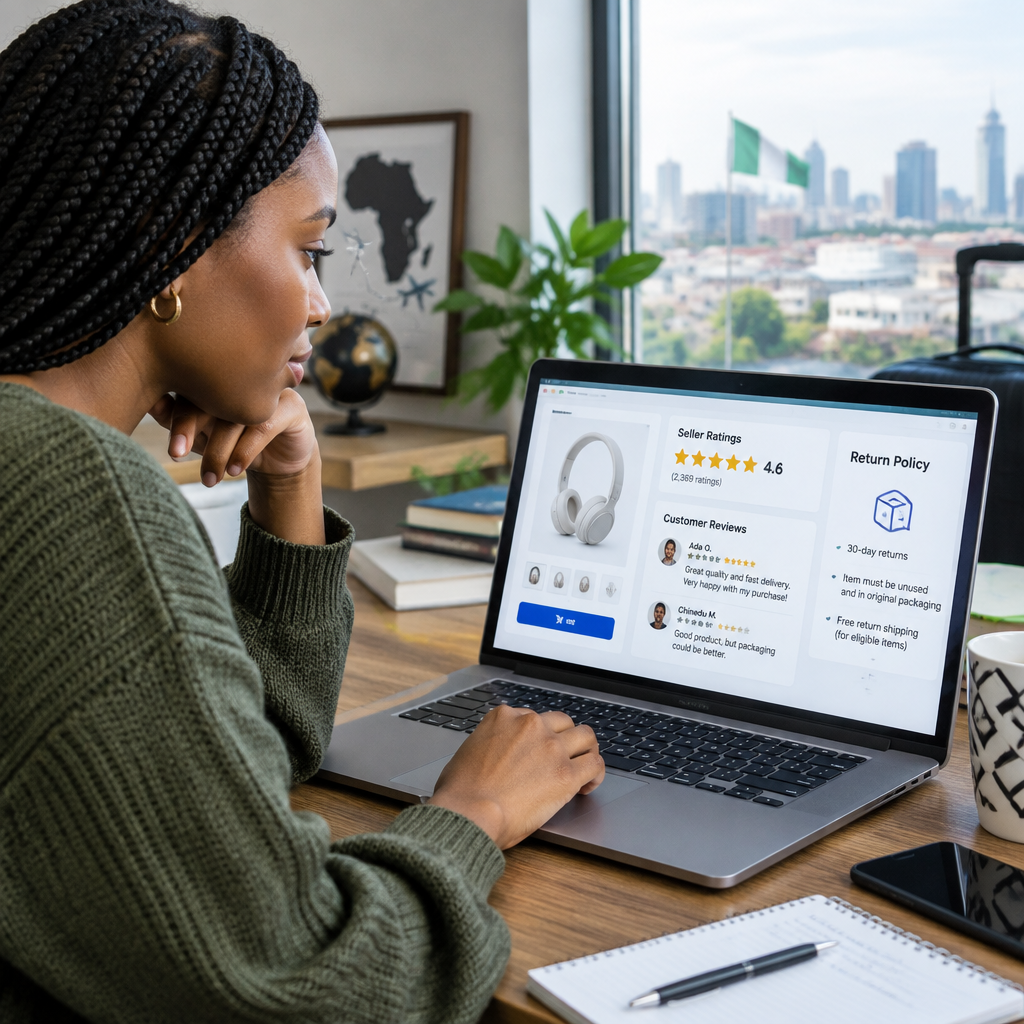
Before buying online, especially from a marketplace or social-media seller, compare three things together: the seller’s rating, the quality of customer reviews and the practical terms for returns or exchanges. This approach can help Nigerian shoppers reduce the risk of receiving counterfeit, damaged or completely different goods.
Advertisement
Table of Contents
Start with the seller’s rating, but check what it represents
A rating is a quick summary of customer feedback. It can help you identify sellers with a history of successful transactions, but it should not be your only basis for a decision.
First, look at the number of ratings. A 5.0 rating from six buyers does not provide the same level of confidence as a 4.7 rating from hundreds or thousands of buyers. A high score with very few ratings may simply mean that there is not enough information yet.
Also check whether the rating applies to:
- The individual seller or the entire marketplace;
- The specific product listing or the seller’s general account;
- Recent transactions or orders made over a long period;
- Verified purchases or comments that may not be linked to a completed order.
Some platforms separate product ratings from seller ratings. A popular product may have good reviews even when a particular seller is unreliable. If possible, examine both the item’s feedback and the seller’s performance.
Read reviews for evidence, not just praise
Useful reviews explain what happened. They may mention the actual condition of the product, delivery experience, packaging, communication with the seller and whether the item matched its description.
Very short comments such as “nice,” “good product” or “received” provide limited information. They may confirm that an order arrived, but they do not tell you whether the item lasted, worked properly or matched the photographs.
When reading reviews, look for details such as:
- Photos or videos taken by customers rather than only promotional images;
- Comments about size, colour, materials, battery life, compatibility or performance;
- Whether the item arrived sealed, complete and free from damage;
- How long delivery took compared with the seller’s stated estimate;
- Whether the buyer received the exact model, quantity or specification ordered.
Pay particular attention to recent negative and average reviews. A one-star review may identify a genuine problem, but it may also describe a buyer’s mistake or an issue unrelated to the product. Read the explanation before deciding how serious it is.
For example, a complaint that a phone accessory did not work may be important if several buyers mention the same compatibility problem. However, one complaint from a buyer who selected the wrong connector may not show that every unit is defective.
Look for patterns rather than one dramatic comment
One unhappy customer does not always mean that a seller is fraudulent. At the same time, a high overall rating should not hide a repeated problem.
Look for patterns across different reviews. Repeated complaints about fake goods, missing parts, poor packaging, unexplained cancellations, refusal to answer messages or demands for payment outside the platform deserve serious attention.
A seller’s response can also provide useful information. A calm, specific response that explains how a problem was handled is more helpful than an aggressive reply that blames every customer. However, a polite response does not prove that the issue was resolved, so consider the original complaint as well.
Understand the difference between returns, exchanges and refunds
These terms are often used as if they mean the same thing, but they do not.
- Return: You send the item back to the seller or platform.
- Exchange: The seller replaces the item with another one, such as a different size or colour.
- Refund: Money is returned to you, subject to the policy’s conditions.
A seller may accept an exchange but refuse a cash refund. Another may offer a refund only when the item is damaged, incorrect or significantly different from the listing. Read the exact policy before paying instead of relying on a phrase such as “easy returns”.
Questions to ask about a return policy
A return policy is useful only if you understand how it works in practice. Check the following points:
- Time limit: How many days do you have to report a problem or send the item back?
- Eligible reasons: Are returns allowed for defects, wrong items, damaged goods, poor fit or change of mind?
- Condition: Must the product be unused, sealed, in its original packaging or accompanied by tags and accessories?
- Return cost: Who pays delivery or courier charges when an item is defective or incorrect?
- Refund method: Will the money return to your card, bank account, wallet or another payment method?
- Processing time: Does the policy explain how the refund is approved and processed?
- Excluded products: Are hygiene items, customised goods, digital products, food, intimate items or opened electronics excluded?
- Proof required: Will you need photographs, an unboxing video, an order number or delivery evidence?
Policies can differ between the marketplace and an individual seller. Save or screenshot the relevant terms before ordering, particularly when the item is expensive.
Compare sellers using the same questions
When several sellers offer similar products, create a simple comparison rather than choosing the lowest price immediately.
| Point to compare | Seller A | Seller B | Seller C |
|---|---|---|---|
| Rating and number of ratings | |||
| Recent review pattern | |||
| Product matches description | |||
| Delivery information | |||
| Return or exchange terms | |||
| Total cost, including delivery |
The total cost matters. A cheaper listing may become more expensive after delivery fees, required accessories or difficult return arrangements. A slightly more expensive seller with clearer product information and stronger buyer protection may offer better value.
Use extra care with electronics, branded goods and high-value purchases
For phones, laptops, smartwatches, appliances and other electronics, compare the exact model number, storage capacity, network compatibility, warranty terms and included accessories. Product photographs can be misleading if several versions use the same image.
For branded goods, reviews may reveal counterfeit products, but reviews are not a guarantee of authenticity. Ask whether the seller provides a verifiable receipt, serial number or manufacturer-backed warranty where appropriate. Avoid paying outside the platform simply because a seller offers a discount for direct transfer.
Before opening a package, record the delivery details and inspect the outer packaging. For an expensive order, an unboxing video may help document what you received. Do not share your card PIN, password, one-time password or other private security information with a seller claiming it is needed to process a return.
Warning signs that should change your decision
- The seller pressures you to pay quickly or move the conversation to an unofficial channel.
- The price is far below comparable listings without a clear explanation.
- Reviews appear copied, repetitive or unrelated to the product.
- The seller’s photos, description and customer comments contradict one another.
- The return policy is missing, vague or impossible to locate.
- The seller asks for payment to a personal account while avoiding the platform’s protection system.
- Many buyers report receiving different items, fake goods or no delivery.
None of these signs alone proves fraud, but several together justify walking away. A seller who refuses to answer basic questions before payment is unlikely to become more helpful after receiving your money.
A practical decision rule before you pay
For a low-cost item, a seller with a reasonable rating, enough completed reviews and a clear description may be acceptable even if the return option is limited. For an expensive or safety-critical item, demand stronger evidence: substantial transaction history, detailed recent reviews, clear warranty or return terms and payment through a method that offers buyer protection.
If you cannot explain what happens when the item is wrong, damaged or never arrives, you are not ready to buy from that listing. Pause, save the product details and compare another seller.
The key takeaway
Good online shopping decisions come from combining evidence. Treat the star rating as a starting point, use detailed reviews to test the seller’s claims and read the return policy before placing an order. For Nigerian shoppers, clear communication, secure payment, delivery records and careful inspection are especially important when a return may involve additional courier costs or delays.
The safest seller is not always the cheapest or the one with the perfect score. It is the seller whose history, product information and after-sale terms are clear enough for you to understand both the likely outcome and your options if something goes wrong.
Advertisement