

Advertisement
Advertisement
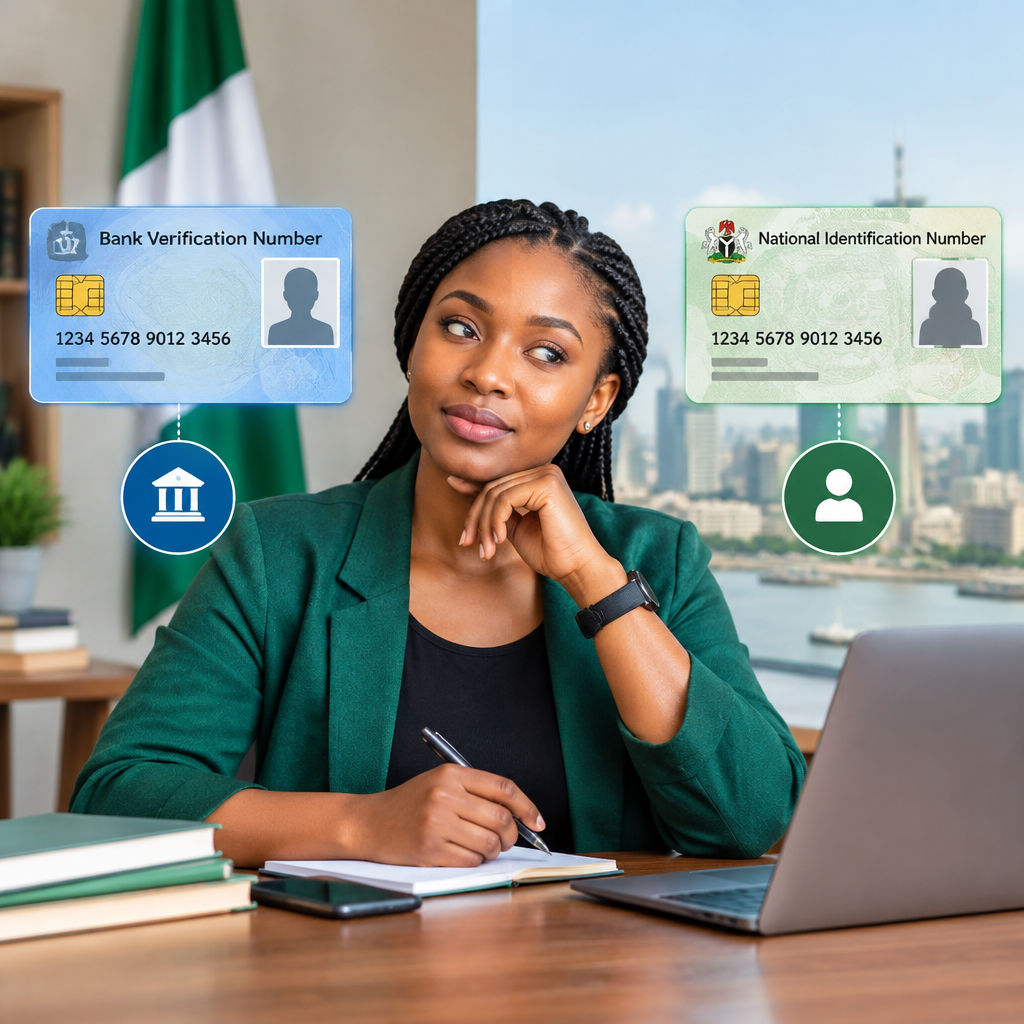
BVN and NIN are both identity numbers, but they do not identify the same record. Your Bank Verification Number (BVN) identifies your banking identity across participating Nigerian banks. Your National Identification Number (NIN) identifies you in Nigeria’s national identity system.
This difference matters when opening or operating a bank account, completing a financial-service verification, applying for certain services or responding to a request to link your identity records. Having one does not automatically mean you have the other.
Advertisement
Table of Contents
What does the BVN identify?
The BVN identifies your customer profile within the Nigerian banking system. It is designed to help banks connect your accounts to one verified banking identity, even when you have accounts with different banks.
For example, a person may have a current account with one bank, a savings account with another and a digital banking relationship elsewhere. The BVN helps participating financial institutions recognise that these accounts belong to the same customer.
BVN enrolment normally involves capturing identity and biometric information through a bank or an approved banking channel. The record is used for customer identification, account management, fraud reduction and compliance processes.
Your BVN is not:
- Your bank account number.
- Your debit card number.
- Your account password, PIN or OTP.
- A replacement for your NIN.
What does the NIN identify?
The NIN identifies you as an individual in Nigeria’s national identity system. It is issued through the National Identity Management Commission, commonly known as NIMC, after identity enrolment and registration.
The NIN is intended to provide a consistent identity record that can be used across approved government and private-sector services. Depending on the service and its current requirements, it may be requested for activities such as identity verification, telecommunications-related processes, financial services, travel documentation or other official applications.
The NIN belongs to you as a person, not to one particular bank. Changing banks does not give you a new NIN. Similarly, opening another bank account does not normally mean you should obtain another BVN.
BVN versus NIN at a glance
| Feature | BVN | NIN |
|---|---|---|
| Full name | Bank Verification Number | National Identification Number |
| Main purpose | Identifies a customer within the banking system | Identifies an individual within the national identity system |
| Primary institution | Banking and financial-sector identity infrastructure | National Identity Management Commission |
| Where it is commonly used | Bank accounts, financial verification and banking compliance | Approved identity checks and selected government or private services |
| Does changing banks create a new number? | No. A customer generally keeps the same BVN | Not applicable. The NIN is tied to your national identity |
| Is it the same as an account number? | No | No |
Why might a bank request both?
A bank may request your BVN and NIN because they serve different verification purposes. The BVN connects you to your banking profile, while the NIN provides a broader national identity reference.
Financial institutions may also be required to collect or verify identity information under applicable regulatory and compliance arrangements. The exact requirement can depend on the type of account, the institution, the customer’s status and current regulatory instructions.
This is why you should not assume that submitting your BVN means your NIN requirement has been completed, or that submitting your NIN automatically supplies your BVN. If a bank asks you to provide or link both, use the bank’s official channel and confirm exactly what action is required.
Simple examples
Opening an account
A bank may ask for identity details during onboarding. It could request your NIN, BVN, or both, depending on its current process and the applicable requirements. Follow the bank’s official instructions rather than relying on an old social media post or another customer’s experience.
Having accounts with several banks
Your accounts at different banks may be connected to the same BVN. Your NIN remains your national identity number regardless of how many bank accounts you hold.
Correcting a name or date of birth
If your personal details do not match across your NIN, BVN and bank records, verification may fail or take longer. The correction route depends on which record contains the error. Do not create a second identity record simply because information needs correction.
What should you do if your details do not match?
- Identify the exact mismatch. Check whether the problem concerns your name, date of birth, phone number, photograph or another detail.
- Ask the requesting institution which record must be corrected. A bank may be able to update its customer profile, but it may not be able to alter a NIMC record.
- Use the responsible organisation’s official correction process. Avoid unofficial agents who promise instant changes or ask for unnecessary sensitive information.
- Keep evidence of legitimate applications and receipts. This can help if you need to follow up.
- Do not enrol for another number because of a mismatch. Duplicate or inaccurate identity records can create further complications.
Can you share your BVN or NIN?
These numbers may be requested for legitimate verification, but they are sensitive personal information. Share them only through a trusted bank, government office or verified service that has a clear reason for requesting them.
Never send your banking PIN, password, OTP, card security code or online-banking login together with your BVN or NIN. A genuine verification request should not require you to disclose those secret credentials.
Be especially careful with messages claiming that your account will be closed immediately unless you click a link or send your details to a personal phone number. Contact your bank through the number on its official website, mobile application or card, not through a suspicious message.
Common misunderstandings
- “BVN and NIN are the same.” They are separate identity systems with different purposes.
- “My account number is my BVN.” Your account number identifies a particular bank account; your BVN identifies your banking customer profile.
- “I can obtain a new BVN from every bank.” Your BVN is generally intended to follow you across participating banks.
- “A NIN card is the same as a BVN record.” A NIN card or slip relates to national identity enrolment, not banking enrolment.
- “Providing an OTP is part of identity verification.” An OTP is a security credential for a specific transaction or login and should not be disclosed to an agent or caller.
The practical takeaway
Think of the two numbers this way: BVN answers, “Which banking customer is this?” NIN answers, “Which person is this in the national identity system?”
You may need both in your dealings with financial institutions, but they remain separate records. Keep your details consistent, follow the current instructions of the relevant bank or government institution, and protect both numbers alongside your other personal information.
Advertisement