

Advertisement
Advertisement
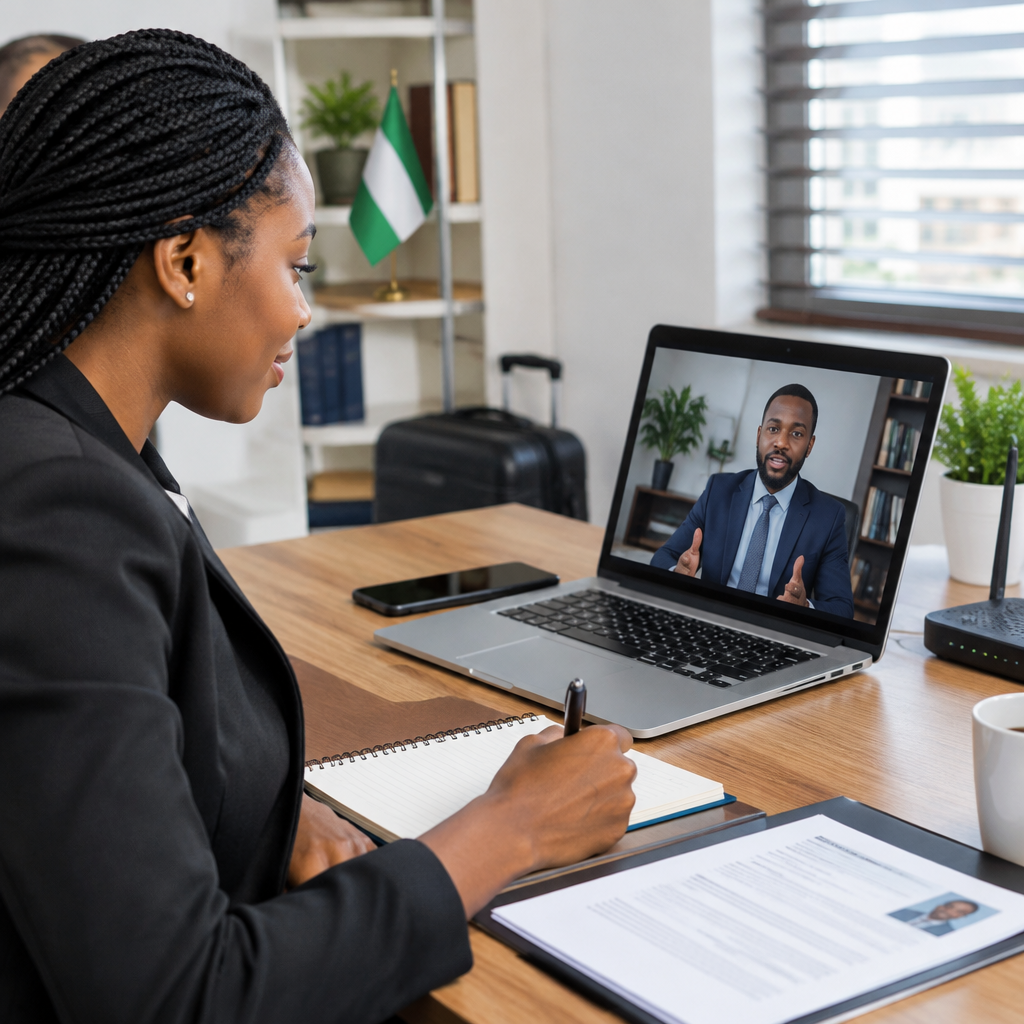
An online job interview can save time and transport costs, but it also creates problems that may not arise in a face-to-face meeting. Poor network service, low phone battery, background noise, unfamiliar video platforms or an unprepared answer can affect how an employer views you.
The best preparation is not only about looking professional on camera. You need to confirm that the interview is genuine, understand the role, test your equipment and prepare clear examples of what you can contribute. This guide is useful for Nigerians interviewing from home, a shared apartment, a campus, a co-working space or while living abroad.
Advertisement
Table of Contents
Confirm that the interview is genuine
Before preparing for the meeting, check that the invitation is connected to a real organisation and a real vacancy. Online recruitment scams often use attractive salaries, urgent messages and requests for money to appear convincing.
Review the sender’s email address, company website, official social media pages and the job advert. Be cautious if the recruiter uses only a personal email address, refuses to explain the role or asks you to pay for registration, training, equipment, background checks or “processing”. A legitimate employer should be able to explain the position and interview process clearly.
Never send your password, banking PIN, one-time password, card details or other sensitive account information during recruitment. An employer may need legitimate documents at a later stage, but you should understand why they are required and how they will be handled.
Study the job description
Read the job description more than once and identify the main responsibilities. Write down the skills, tools and experience the employer appears to value. Then match each important requirement with a specific example from your work, education, volunteering, business or personal projects.
For example, if the role involves customer service, prepare a story about how you handled a difficult customer or solved a complaint. If it involves digital work, be ready to discuss a website, online campaign, spreadsheet, design, writing project or social media task you completed.
Use a simple structure when answering experience-based questions:
- Situation: What was happening?
- Action: What did you personally do?
- Result: What changed or what did you learn?
Do not memorise long speeches. Prepare key points so your answers sound natural and remain relevant to the question.
Prepare answers to common questions
Most interviews include questions about your background, interest in the role and ability to work with others. Practise answering these questions aloud:
- Tell us about yourself.
- Why are you interested in this position?
- What do you know about our organisation?
- What are your strongest skills?
- Describe a problem you solved.
- Tell us about a mistake and what you learned from it.
- How do you manage deadlines or competing tasks?
- What salary range are you expecting?
- When can you start?
Your answer to “Tell us about yourself” should focus on your professional background, relevant skills and connection to the role. It should not be a complete account of your childhood or every job you have ever had.
When discussing weaknesses, avoid claiming that you have no weaknesses. Choose a genuine area you are actively improving and explain the practical steps you are taking. For example, you might describe how you now use a task list and calendar reminders to manage several deadlines.
Research the employer without making assumptions
Learn what the organisation does, who it serves and what its products or services are. Check its official website and public professional pages. If the organisation is in digital media or online services, look at the type of information, technology guides, tutorials or services it provides. This can help you ask more informed questions and show that you understand its work.
Do not rely only on rumours or unverified social media comments. If information about the organisation is unclear, ask respectful questions during the interview. You are also assessing whether the employer offers a genuine and suitable opportunity.
Test your internet connection and device
Do not wait until the interview starts before testing your setup. At least one day before the meeting, check the following:
- Confirm the date, time and time zone.
- Install or update the required video-call application.
- Test your camera, microphone and speakers.
- Check that your device has enough storage and battery.
- Use a stable internet connection and prepare mobile data as a backup.
- Close downloads, streaming services and unnecessary applications.
- Keep the meeting link and recruiter’s contact details somewhere accessible.
If you are using a phone, place it on a stable surface rather than holding it throughout the call. Position the camera close to eye level. Clean the camera lens and turn off notifications that could interrupt the interview.
Have a backup plan for a network problem. You could move to another location, switch between Wi-Fi and mobile data or rejoin using your phone. If you lose connection, contact the interviewer briefly and explain the problem instead of disappearing without notice.
Choose a suitable interview space
Select the quietest available location with good lighting. Face a window or light source where possible, but avoid sitting with a bright window directly behind you. A plain and tidy background is usually better than a busy room.
Tell people around you that you have an interview and ask them not to interrupt you. Silence television, music and unnecessary phone alerts. If you live in a noisy environment, inform the interviewer at the beginning if occasional background sound may occur, but still make every reasonable effort to reduce it.
You do not need an expensive office or camera. A clean appearance, clear audio, stable framing and respectful communication are more important than a perfect background.
Dress and behave professionally
Dress as you would for a serious in-person interview. Choose clean, comfortable clothing that is appropriate for the organisation and position. Avoid clothing with distracting writing or patterns that may look unclear on camera.
Join the meeting a few minutes early. Look at the camera when speaking, listen carefully and avoid interrupting. If the audio cuts out, politely ask the interviewer to repeat the question. It is better to request clarification than to give an unrelated answer.
Keep your CV, the job description, a notebook and a pen nearby. You may also keep short reminders on your screen, but do not read every answer. Excessive typing, looking away or checking another device can make you appear distracted.
Prepare questions for the employer
An interview should help you understand the job, not only help the employer assess you. Prepare two or three questions such as:
- What would the successful candidate be expected to achieve in the first few months?
- Who would I report to, and how is performance assessed?
- What does a normal working day or week look like?
- Which tools or platforms does the team use?
- What are the next steps after this interview?
For remote or hybrid roles, ask how communication, working hours, meetings and equipment are handled. If the role involves online services, websites, content or customer support, ask how tasks are assigned and reviewed.
Discuss salary carefully
If salary comes up, answer honestly and professionally. Consider the responsibilities, your experience, the working arrangement and the full benefits package. If you do not know the employer’s range, you can ask whether a budget has been set for the position.
Do not agree immediately to terms you do not understand. Ask whether the stated amount is monthly or annual, the expected working hours, payment schedule, probation conditions and any deductions that are clearly explained. Never send money in order to receive a job or salary.
Follow up after the interview
After the meeting, write down the important points while they are still fresh. If appropriate, send a short thank-you message confirming your interest and referring to one relevant part of the discussion. Keep it professional and avoid sending repeated messages demanding an immediate decision.
If the recruiter gives a date for feedback and does not respond, one polite follow-up is reasonable. Continue applying for other suitable opportunities until you receive a clear written offer and understand its terms.
A simple preparation checklist
- Verified the employer and vacancy.
- Read and understood the job description.
- Prepared relevant examples from your experience.
- Tested the device, camera, microphone and internet.
- Arranged backup data, power and a contact method.
- Selected a quiet, well-lit space.
- Prepared your CV, notebook and questions.
- Checked the interview time and platform.
- Planned what to do if the call drops.
- Confirmed that you will not pay money or share confidential security details.
The strongest online interview preparation combines competence with reliability. Show that you understand the role, communicate clearly, can handle ordinary digital tools and take sensible steps when something goes wrong. For Nigerian jobseekers, this preparation is especially valuable because it reduces avoidable technology problems while helping you identify recruitment scams before they cost you money or personal information.
Advertisement